Wednesday, 17 January 2018
Congratulations & Farewell, Molly Richards
The Library staff would like to thank Molly Richards for the time she spent with us as a trainee librarian (August 2017 - January 2018), and wish her all the best in her new post working at the Oxford English Dictionary.

Friday, 10 November 2017
Foundation Day Tuesday, 21st November 2017
Foundation Day, Tuesday 21st November 2017
The library normally closes early to allow for the Foundation day ceremonies but this year the building will be closed for the entire day. There will be no access into either the North or the South Block. The Institute of Classical Studies Library / Hellenic and Roman Societies Library will be closed from Monday 6.00 p.m. until Wednesday 22nd November 9.30 amThis is on the advice of the Metropolitan Police in order to ensure a safe environment for Foundation Day guests. The Warburg Institute in Woburn Square will remain open.
We apologise for the inconvenience caused.
Wednesday, 18 October 2017
Monsters Display in the Library
We've been celebrating monsters this past week at the Institute of Classical Studies. In honour of this, Deputy Librarian, Paul Jackson, has put together a display of monster-related rare books.
Why not venture down to the library to explore some of the treasures from our collection?
The books on display include:
Homer's Odyssey, translated by Henry Cotterill and illustrated by Patten Wilson
Geography of Ptolemy, with maps and monsters as imagined by Gerhard Mercator
Why not venture down to the library to explore some of the treasures from our collection?
 |
| Map featuring sea monsters by Gerhard Mercator (see below for detail) |
The books on display include:
Homer's Odyssey, translated by Henry Cotterill and illustrated by Patten Wilson
 |
| The Sirens, illustrated by Patten Wilson |
Geography of Ptolemy, with maps and monsters as imagined by Gerhard Mercator
 |
| Detail from map by Gerhard Mercator showing a sea monster |
Peintures antiques et inédites de vases grecs tirées de diverses collections, complete with illustrations
 |
| Heracles struggling with the sea-god, Nereus by James Millingen |
The display also includes images and descriptions of the Sphinx; a depiction and analysis of the Centaurs battling the Lapiths on the Parthenon Frieze; two dictionaries, open to definitions for monstrum and τέρας; images and translations of Odysseus escaping the deadly Scylla and Charybdis; Dryden's translation of Virgil's Polyphemus, the one-eyed giant, and more.
The display will be available to view until the end of October.
If you want more monsters in your life, don't forget to check out part 1 and part 2 of our monster books reading list.
Monday, 16 October 2017
Monster Books - Part 2
The Institute of Classical Studies is holding a free public event entitled Why do we need monsters? on Tuesday 17th October. In honour of this, we went on a heroic hunt for the monsters, beasts and demons hidden away in our library. The fruits of our Herculean labours can be found below - whether you’re interested in art, literature, language or history, there’s something for you. In case you missed part 1, you can find it here.

Monsters and monstrosity in Augustan poetry, Lowe, D
Dr Lowe looks at how poets, such as Ovid and Virgil, reinvented the monsters of Greek myth to explore political, social and aesthetic developments in Rome. The monsters discussed include the Centaurs and the Minotaur in their role as hyper-masculine, brutish beast-men, and the desirable, but dangerous, Medusa. Dr Lowe will be speaking at the Why do we need Monsters? event on ‘Real monsters in ancient Rome’, so why not go along to hear more?
Mythical monsters in classical literature, Murgatroyd, P
Want to know more about Sirens, Cyclopes and Vampires? This book covers the representation of all your favourite monsters in literature, from the ancient world all the way up the to the 21st century.

Dictionary of deities and demons in the Bible (DDD), van der Toorn et al. (eds.)
This reference book details the gods, demons, angels, spirits and semi-divine heroes who feature in the bible. The entries include discussions of the name’s meaning and etymology; the individual’s role outside the bible; the individual’s role in Biblical texts; bibliographical information.
In this book, Shepard discusses the depiction of the merman, the hippocamp and the ketos in Greek and Etruscan art across a range of media, including tomb paintings, jewellery and monuments.

The animal part: human and other animals in the poetic imagination, Payne, M
This book examines how verse writers, from antiquity to the present day, have explored animal experiences and suffering, and communicated them to a very different kind of beast in their human audience.

Friday, 13 October 2017
Monster Books – Part 1
The
Institute of Classical Studies is holding a free public event entitled Why do we need Monsters? on Tuesday 17th October. To
celebrate this, we set out on our very own quest through our labyrinthine
library, hunting out the monsters, beasts and creatures lurking amidst our book
shelves. Check out the list below for the spoils (books) we’ve amassed -
whether you’re interested in art, literature, language or history, we’ve tried
to find something you might like to add to your reading list. Keep watch for
part 2 next week for more terrible tomes!
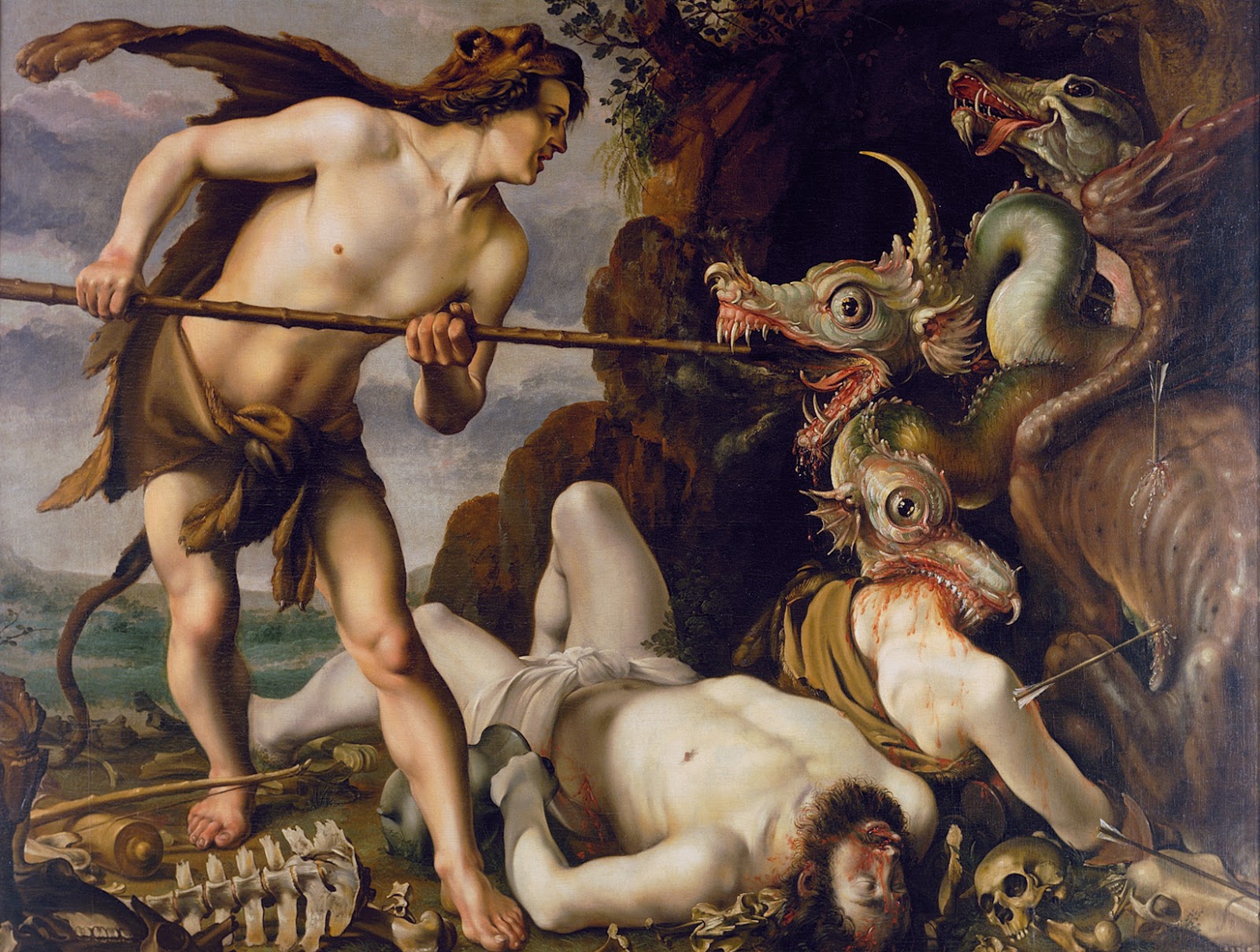 |
| The Dragon Devouring Cadmus' Companions, Hendrick Goltzius |
Professor
Wengrow looks at the production and transmission of images of monsters across
ancient societies, such as Mesopotamia, Egypt, Greece and China, and explores
the relationships between image, cognition and early state formation. Professor
Wengrow will be speaking at the Why do we need Monsters? event on ‘What
is a monster, and do we really need them?’ so why not go along to hear more?
 |
| Composite creatures from Syria, as discussed by Professor Wengrow |
Monsters and monstrosity in Greek and Roman culture, Atherton, C (ed.)
This
collection of five essays explores monsters in a whole range of contexts,
covering: the representation of Polyphemus in the Odyssey; the depiction
of monsters, ogres and demons in Old Comedy; the liminal role of monsters,
especially in ritual contexts; the status of Talos, the bronze giant of Crete;
the role of animals and beasts in Roman religion.
Creatures of speech: lion, herding and hunting similes in the Iliad, Lonsdale, S. H.
Homer is famous for his similes, but have you
noticed how many lions there are in them? This book looks at such
similes in the Iliad, examining the recurring themes, the contexts in
which they are used, and how they relate to the surrounding narrative.
Herakles and the sea-monster in Attic black-figure vase-painting, Ahlberg-Cornell, G
In this book, Ahlberg-Cornell looks at the
depiction of Herakles fighting with a sea-monster (variously Nereus or Triton)
in over 130 black-figure vase paintings, exploring the development and
significance of this theme. Illustrations of all the vases are included.
 |
| One of the vases depicting Herakles struggling with the sea-monster |
Spectacles of empire: monsters, martyrs, and the Book of Revelation, Frilingos, C. A.
Frilingos looks at the Book of Revelation
(including its seven-headed beast) and how it uses the spectacle and
theatricality central to Roman life to engage its audience.
The beasts, birds, and bees of Virgil : a naturalist's handbook of the Georgics, Royds, T. F.
This book surveys the animals – from horses and
goats to gadflies and weevils - of Virgil’s Georgics.
Friday, 22 September 2017
Library Lobby Renovations 3!
We have some exciting news - the lobby renovations are almost complete.
We are due to return to the main entrance on the 3rd floor this Monday (25th September).
The library will be open as usual on Monday. However, since library equipment will be being moved throughout the day, there may be some disruption. We apologise in advance for this and thank you for your patience.
We will have some photos of our new lobby to share with you soon!
The Library Team
We are due to return to the main entrance on the 3rd floor this Monday (25th September).
The library will be open as usual on Monday. However, since library equipment will be being moved throughout the day, there may be some disruption. We apologise in advance for this and thank you for your patience.
We will have some photos of our new lobby to share with you soon!
The Library Team
Wednesday, 13 September 2017
Library Filming
Our beloved library is taking on a starring role in a promotional film for the Hellenic and Roman Library appeal. The film will give a flavour of the library's collection and how it's used, and aims to raise funds to ensure the library continues to be an accessible, world-class research facility.
The filming will take place this Friday and Saturday (15th - 16th September).
The library will be open as usual while the filming takes place.
We want to show the library in all its functional glory and so if you happen to be using the library on these days, you may appear in the background (as an extra, if you will!). Anyone who features more prominently will be asked to complete a Contributor Release Form.
If you would prefer not to appear in the film, please speak to a member of staff or filming crew.
Finally, while we will try to keep disruption to a minimum, we apologise in advance for any inconvenience the filming causes.
The filming will take place this Friday and Saturday (15th - 16th September).
The library will be open as usual while the filming takes place.
We want to show the library in all its functional glory and so if you happen to be using the library on these days, you may appear in the background (as an extra, if you will!). Anyone who features more prominently will be asked to complete a Contributor Release Form.
If you would prefer not to appear in the film, please speak to a member of staff or filming crew.
Finally, while we will try to keep disruption to a minimum, we apologise in advance for any inconvenience the filming causes.
Subscribe to:
Posts (Atom)