Thursday, 3 May 2012

Disrupted access to the British Library


Readers who also use the nearby British Library should be aware that they may experience some disruption next week due to industrial action:
"Members of the Public and Commercial Services Union (PCS) have voted for a one day strike on Thursday 10 May 2012 over changes to public sector pensions.
The British Library at St. Pancras plans to be open as usual for visitors to its public areas and exhibition galleries, but there is likely to be significant disruption to our Reading Room services with the potential of late opening and some rooms likely to remain closed.
Further, we may only be able to facilitate a maximum of five requests per person in Reading Rooms that are open on 10 May, and no transfers will be possible between Reading Rooms in St. Pancras.
Although every effort will be made to maintain opening hours of available rooms until 20.00, there is a possibility of early closure at 17.00.
We plan to open the Boston Spa Reading Room and the Newspaper Library at Colindale but there may be disruptions to our services.
We urge all Readers to check any changes to the Library's opening hours and available services. We will keep you updated on our website - please see the homepage at http://www.bl.uk/.
Thank you for your understanding.

Romania celebrates Roman heritage with...awkward naked Trajan and a levitating wolf in a scarf

From the BBC: "A statue representing the birth of the Romanian nation has been greeted with derision by the public and critics.

The sculpture, unveiled outside Bucharest's National History Museum, portrays a naked Roman emperor Trajan carrying a wolf.

It is supposed to represent the fusion of the Roman empire with the ancient tribes of Dacia."

Image from the Romanian Times
Any thoughts?

Wednesday, 2 May 2012

Why do old books smell?

A team of scientists from UCL and the University of Ljubljana, Slovenia, are working on a detector to investigate the composition of paper to assist in the conservation of old books without having to destroy part of them for chemical analysis. More on the Guardian's GrrlScientist blog.

Wednesday, 18 April 2012

Ancient and Modern Olympics Blog

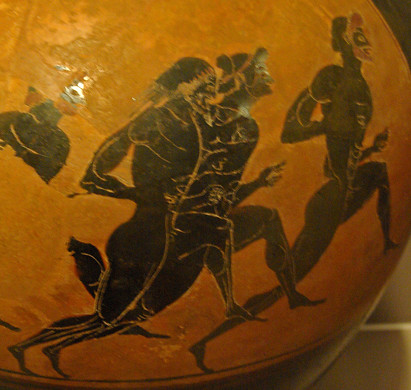
Cursa
Image via Flickr user Sebastia Giralt

For those interested in the ancient Olympics, in light of the upcoming London games, Dr Jason König from the University of St. Andrews has started a blog about the games: http://ancientandmodernolympics.wordpress.com/

Tuesday, 17 April 2012

L'Année Philologique in danger


The German office of the Année Philologique is due to have its funding withdrawn at the end of the year, seriously jeopardising the validity of the publication as a comprehensive bibliographic source.

From their website:
The Année Philologique, a critical and analytical bibliography of Greco-Latin Antiquity, has existed since the 1920s : over the years, its generalist orientation has made it a working tool that is useful for all, whatever one's specialty may be. Since its creation and its dissemination on paper, it has been a bibliographical tool that is universally recognized, utilized, and appreciated by students of Antiquity throughout the world. Since 2002, its dissemination online has facilitated the access of an ever-broader public to the bibliographical data it offers.
However, this irreplaceable tool is threatened, in the very near future, with disappearing in its current form, and perhaps with simply ceasing publication.
The cause of this threat is simple : the German office of the Année Philologique, the Zweigstelle Heidelberg, must close its doors at the end of the fiscal year 2012, unless a durable source of funding is found. The Heidelberger Akademie der Wissenschaften, which has funded it until now, has let it be known that it will cut off all subsidies at that date. In so doing, it is applying the government's decision to no longer fund continuing projects and positions, but to henceforth grant funds only to short-term scientific operations, answering to invitations to tender. If it were to take effect at the planned date, this programmed closure would have disastrous consequences for the entire project : with it, the totality of German-language research, whose importance for the classical humanities is known to all, would cease to be covered by our publication. Quantitatively, this would mean a decrease of approximately 30% of the bibliographical items made available to the public.
Unless a solution is found, the consequences will boil down to a sinister alternative : the transformation of a project of high scientific value into a bargain-basement search engine, or the outright disappearance of the publication.

For more information, and to sign a petition in support: http://anphil.org/en/forms/petition

Thursday, 12 April 2012

Bodleian and Vatican libraries to digitise ancient texts

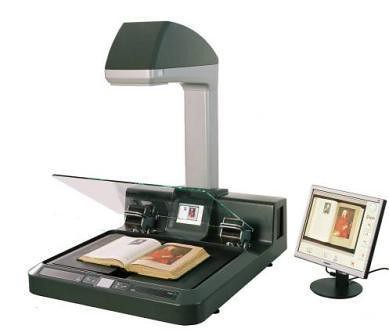
Copibook book scanner and book copier for bound documents
Image via Flickr user adrienpoly


The Bodleian Libraries and the Biblioteca Apostolica Vaticana have received a £2 million grant from the Polonsky Foundation to launch a collaborative digitisation project, with the aim of making over 1.5 million pages from their collections freely available to the wider public. Over the next four years, the project will digitize Greek manuscripts, incunabula, early printed books and Hebrew manuscripts from both collections, allowing them to transcend the limits of time and space!

L'Osservatore Romano provides some information on the texts to be digitised from the Vatican collections.